Can a Baby Sleep With a Fan On? Safety Tips for Every Nursery
A running fan won't hurt your baby, and the science actually says it can help them sleep safer and cooler. Here's what to know about picking the right fan, the one placement rule that matters most, and how to keep your nursery comfortable all night.




Updated October 6, 2026
AI Summary


Hot nights and a stuffy nursery have a way of turning into late-night worry sessions. You crack the door, check the thermostat, and wonder if that little fan humming in the corner is helping or somehow putting your baby at risk.
But can a baby sleep with a fan on safely? Yes, and the research on fans and newborns is actually pretty reassuring. This guide explores how a fan can help lower the risk of SIDS, advice on choosing the right fan, and the safety rules that matter most, including exactly where to aim it.
» For the bigger picture on getting the whole room right, see this guide to setting up a safe sleep nursery.
What Is Fan Death?
Let's start with the myth: Korean fan death. It's a belief, mostly circulated in South Korea, that sleeping in a room with a running fan can be dangerous.
The theory claims a fan lowers your body temperature too far, reduces the oxygen in the room, and raises carbon dioxide levels. But none of that holds up. Fan death has been thoroughly debunked, and there's no physical mechanism by which a fan could cause the harm the myth describes [1].
If you've never heard of fan death, it's easy to write off as silly. But plenty of people believe it, and that belief can do real harm. Skipping a fan out of fear of a myth means missing out on benefits that actually help protect your baby.
When safety is your top priority, a video baby monitor will help you keep tabs on what's happening while your baby sleeps.
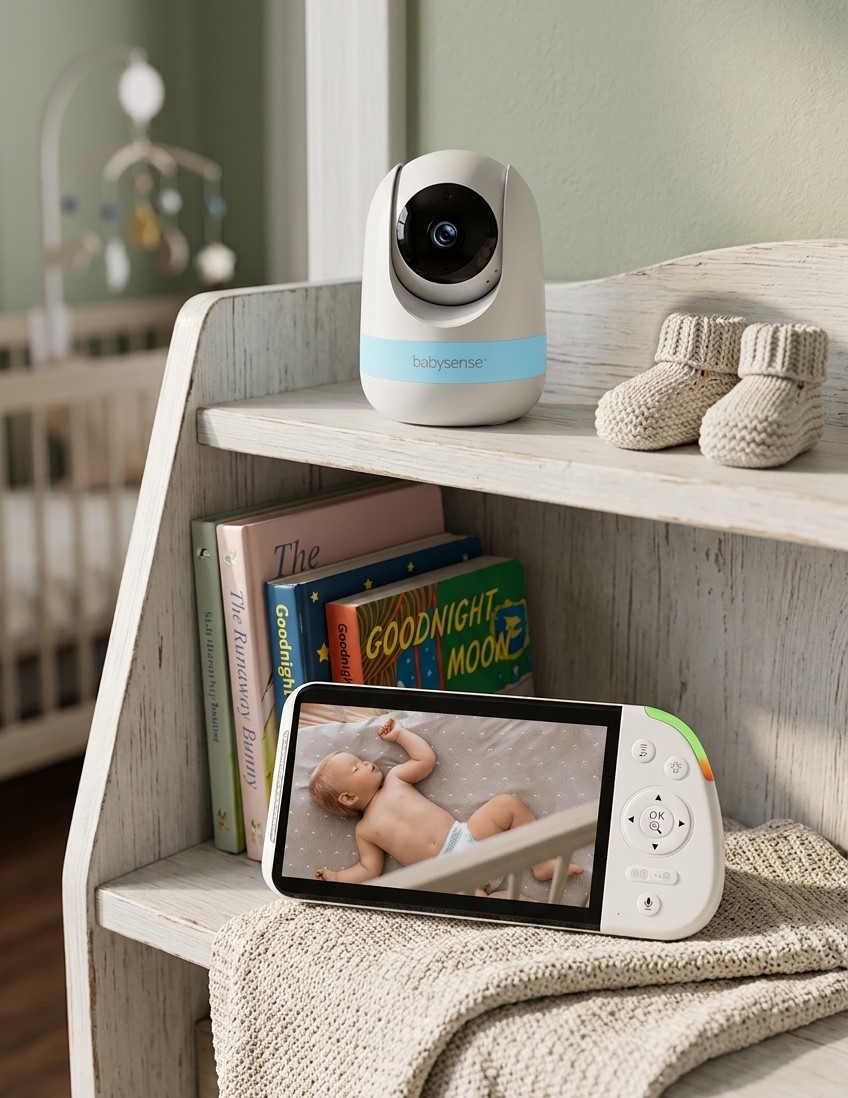
Watch Nursery Temps at a Glance
Babysense non-Wi-Fi monitors show your baby's room temperature right on the parent unit.
Reducing the Risk of SIDS
Sudden Infant Death Syndrome (SIDS) is the leading cause of death in babies between one month and one year old. One of the biggest benefits of running a fan in your baby's room is that it can help reduce the likelihood of SIDS. In fact, research shows it may reduce this risk by as much as 72% [2].
Researchers aren't entirely sure why, but one leading theory points to carbon dioxide buildup from a baby's own exhaled air while they sleep. More airflow around the crib may help clear that buildup before it becomes a problem.
SIDS Safety Checklist
A fan is only one part of a bigger picture. The American Academy of Pediatrics recommends pairing it with these safe sleep practices [3]:
- Put your baby to sleep alone in their crib, not in a shared bed with parents.
- Keep the crib free of blankets, pillows, toys, and other loose items.
- Use a firm, flat mattress that fits the crib exactly, with no gaps.
- Keep your baby away from second-hand smoke.
- Keep the room at a cool, comfortable temperature.
SIDS still isn't fully understood, but these steps have shown real results in reducing the risk. Talk to your pediatrician about what's right for your baby specifically.
Maintaining the Correct Temperature
A fan does double duty by helping regulate your baby's room temperature too. Aim for somewhere between 65 and 70°F, though the thermostat only tells part of the story.
Check your baby directly to make sure they're not too warm or too cold:
- Feel their hands and feet first. A slight chill there is normal, but they shouldn't feel cold to the touch.
- Then check their belly. If it feels warm, take their temperature to rule out a fever.
- If the sheets feel cold, warm them before bedtime. Tuck a water bottle into the crib for a few minutes, then remove it before putting your baby down.
» For more details on keeping the room in that sweet spot, see our full guide to nursery temperature and humidity.
Fans and White Noise
White noise is a sound made up of many frequencies at equal intensity, and it's one of the quieter perks of running a fan. Machines built specifically for white noise exist, but a standard fan, or an air conditioner, does the job too.
White noise has real benefits for babies, supported by research. In one clinical trial, 80% of newborns fell asleep within five minutes when exposed to white noise, compared with just 25% in a quiet room [4]. It also masks sounds from elsewhere in the house, so the dishwasher or a sibling's TV doesn't wake your baby.
What Kind of Fan Is Best for a Baby's Room?
Not every fan works well in a nursery. When you're choosing a fan for baby room use, keep these things in mind:
- Noise level: You don't want an overly loud fan, but an ultra-quiet one won't do much either. A fan with a bit of hum helps block sounds from elsewhere in the house.
- Secure placement: Make sure it has a solid stand or a secure clip so it won't tip over while running.
- Power source: A cord can be a hazard if it's within reach of a curious baby, but constantly replacing batteries gets old fast. Weigh which trade-off works better for your setup.
- Flexibility: Look for adjustable speed settings and a neck that swivels, so you can redirect the airflow as needed.
You don't need a fan marketed specifically for nurseries. Any well-made fan works fine as long as you use it safely.
Is a Fan Better Than a Home Air Conditioner?
If your home already has A/C, you might wonder whether you even need a fan. Mostly it comes down to preference, though a few things are worth knowing:
1. Temperature
If your home is already fairly cool, in the 60s or low 70s, a fan can make the room feel more comfortable without actually dropping the temperature. However, if the home is in the 80s or 90s, you'll probably want to turn the A/C on for a while to cool the room down.
2. Running Costs
A fan is the cheaper option by far. Running a fan alongside your A/C also makes the system more efficient, since moving air lets you set the thermostat a few degrees higher while the room still feels just as cool [5]. That means less strain on the A/C and a lower energy bill.
3. Humidity Levels
There's also a humidity upside worth knowing. Air conditioning dries out the air in a room, but a fan just circulates the air that's already there. If your baby has a skin condition like eczema, or a respiratory issue like asthma, drier air isn't ideal. In that case, a fan might be the better choice.
» Is humidity an issue at home? We offer helpful advice on caring for your baby in high-humidity conditions.
Is a Ceiling Fan or Standing Fan Better?
Both styles are safe choices for a nursery. The right one usually comes down to your budget, your room layout, and how much flexibility you want. Here's a quick comparison of the two:
| Ceiling Fan | Standing Fan |
|---|---|---|
Cost | Higher, plus installation | Lower, plug-and-play |
Flexibility | Fixed in place | Easy to move and reposition |
Crib placement | Keep the crib out from directly underneath | Position across the room, angled away |
Child-safety risk | Very low once installed correctly | Needs a stable base and secured cord |
Best for | Whole-room airflow, permanent nurseries | Renters, smaller rooms, easy repositioning |
Is It Okay to Have a Ceiling Fan on With a Newborn?
Yes, it's fine at any age, as long as the airflow stays gentle and indirect rather than blowing straight down on your baby.
9 Safety Tips for Running a Fan in Your Baby's Room
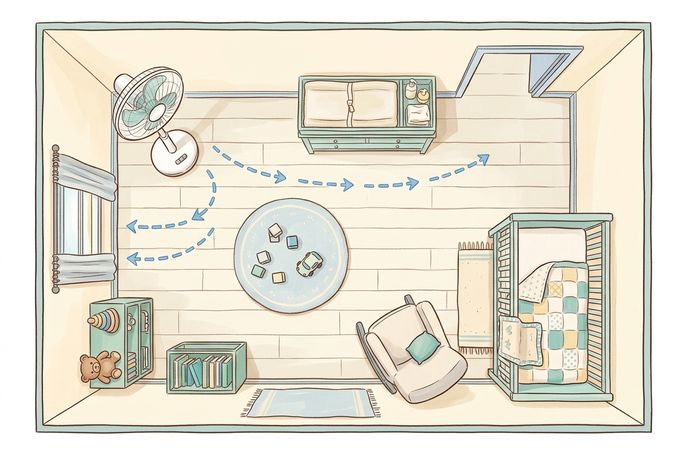
While fans are generally safe for use in the nursery, make sure you follow the following safety tips:
- Buy new: Avoid fans from secondhand stores or hand-me-downs. Used fans can have internal electrical problems that are hard to spot.
- Watch for recalls: The Consumer Product Safety Commission keeps an updated list of all product recalls [6].
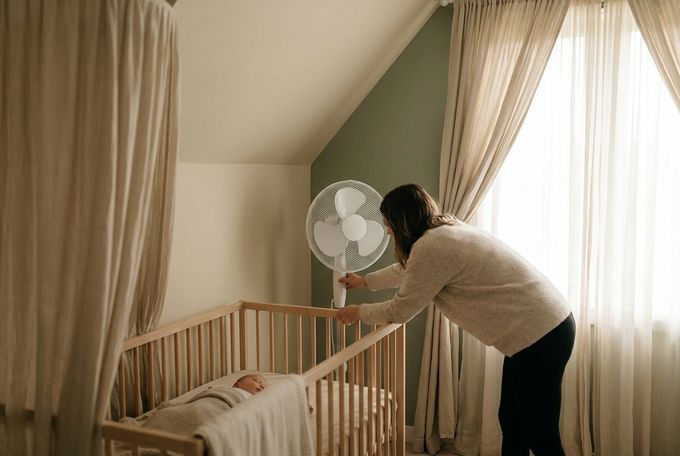
- Secure the fan: Make sure the clip or stand holds it firmly in place, and position it so it can't fall into the crib even if it does tip.
- Keep it and its cord out of reach: Position the fan and any cord well away from the crib, and never drape a cord across or near where your baby sleeps.
- Use a fan guard: This mesh cover fits over the blades, keeping little fingers out without blocking airflow.
- Inspect for damage: Check the cord, plug, and housing regularly for fraying, cracks, or other wear.
- Plug directly into a wall or surge protector: Don't use extension cords. A direct connection is safer and less likely to overheat.
- Skip the extras: Don't attach streamers, toys, or anything else to the blades.
- Don't point the fan directly at your baby: Aim it across the room or toward a wall instead, so the air circulates rather than blowing straight onto the crib.
It's easy to set up your fan and forget about it, but taking the time to give it a quick check regularly can help prevent a dangerous situation from developing.
Other Tips for Keeping Baby's Room Comfortably Cool
A fan is a big part of the equation, but it's not the only tool. A few other easy ways to keep things cool:
- Close the curtains during the day: Keeping direct sunlight off the crib and out of the room prevents unnecessary heat buildup before bedtime.
- Help air move naturally: Cracking a window or leaving the door open (when it's safe to do so) lets cooler air circulate alongside the fan.
- Offer extra feeds in hot weather: Bottle-fed babies can benefit from an increased intake of water throughout the day when the weather is warm to prevent dehydration.
- Try a lukewarm bath before bed: It's a gentle way to help your baby's body settle into a cooler, sleep-ready state.
- Keep an eye on the actual room temperature: Your house thermostat doesn't provide information that's precise enough.
Instead of hunting down a separate nursery thermometer, many Babysense monitors, including our non-Wi-Fi video monitors, show you real-time room temperature right on the parent unit's screen.
Rest Easy About the Nursery Fan
So, can a baby sleep with a fan on? Yes! It's not only safe, but also comes with research-backed benefits. A running fan can help lower the risk of SIDS and overheating while creating a calm, quiet environment for your baby to rest in. Just remember the one rule that matters most: keep it aimed away from the crib, not at it.
You can't check the thermometer every hour, especially at 2 am. That's where a monitor that does some of the watching for you comes in handy. The Babysense Touch lets you check in on your baby as well as the room's temperature and humidity at the same time, so you're never guessing whether the fan is doing its job.
References
1. Snopes. (n.d.). Fan death. https://www.snopes.com/fact-check/fan-death/
2. Coleman-Phox, K., Odouli, R., & Li, D. K. (2008). Use of a fan during sleep and the risk of sudden infant death syndrome. Archives of Pediatrics & Adolescent Medicine, 162(10), 963–968. https://pubmed.ncbi.nlm.nih.gov/18838649
3. American Academy of Pediatrics. (2022). Sleep-related infant deaths: Updated 2022 recommendations for reducing infant deaths in the sleep environment. Pediatrics, 150(1), e2022057990. https://publications.aap.org/pediatrics/article/150/1/e2022057990/188304/Sleep-Related-Infant-Deaths-Updated-2022
4. Spencer, J. A., Moran, D. J., Lee, A., & Talbert, D. (1990). White noise and sleep induction. Archives of Disease in Childhood, 65(1), 135–137. https://pmc.ncbi.nlm.nih.gov/articles/PMC1792397/
5. U.S. Department of Energy. (n.d.). Fans for cooling. Energy Saver. https://www.energy.gov/energysaver/home-cooling-systems/fans-cooling
6. U.S. Consumer Product Safety Commission. (n.d.). Recalls. https://www.cpsc.gov/Recalls
FAQs
Is it safe to leave a fan running all night in the nursery?
Yes. A fan can run all night as long as it's set up safely. It should be securely placed, plugged directly into the wall, and angled away from the crib. Many parents find the steady airflow and white noise help babies sleep more soundly through the night.
Can babies sleep with a ceiling fan on?
Yes, ceiling fans are just as safe as standing fans for a nursery. The main rule is to avoid placing the crib directly underneath one, purely as a precaution, since it's extremely unlikely the fan itself would ever fall.
What's the best kind of fan for a baby's room?
Look for a fan with a secure base or clip, adjustable speed settings, and a neck that swivels so you can redirect the airflow. It doesn't need to be marketed specifically for nurseries, just well-made and used safely.
Is a fan or an air conditioner better for a nursery?
Both work well, and many parents use them together. A fan is cheaper and preserves humidity, while A/C is better for bringing down the temperature in a genuinely hot room. Running a fan alongside your A/C can also make it more efficient.
What temperature should I keep the nursery at when running a fan?
Aim for 65 to 70°F. A fan helps maintain that range, but always check your baby's hands, feet, and belly directly, since the thermostat only tells part of the story.
Can a fan make my baby sick or give them a cold?
No. Colds come from viruses, not from moving air, so a fan won't cause one. However, direct, sustained airflow can dry out skin or eyes over time, so keep it indirect rather than pointed straight at them.